3.6.6. DLT Logging Plugin
The DLT logging integration adds an optional tracing output that forwards application log and trace events to the AUTOSAR Diagnostic Log and Trace (DLT) daemon via the DLT system library. Integration into the Tracing Stack The DLT output is realized as an additional subscriber layer within the existing layered tracing architecture. The tracing system composes multiple output layers (terminal, file, OpenTelemetry, DLT) into a single subscriber. When DLT is enabled, its layer receives the same tracing events as all other layers and translates them into DLT log messages.
Compile-Time Feature Gating The entire DLT integration is guarded by a compile-time feature flag. When the feature is not active:
When the feature is active, the DLT layer is only added to the tracing subscriber if the runtime configuration also enables it. Runtime Enablement At startup, the tracing initialization checks the DLT configuration. If DLT support is compiled in but disabled in the configuration, the DLT layer is not registered, and no connection to the DLT daemon is established. Log Level Mapping Application trace levels are mapped to their DLT equivalents by the DLT subscriber layer, ensuring that severity-based filtering in DLT tooling works as expected. |
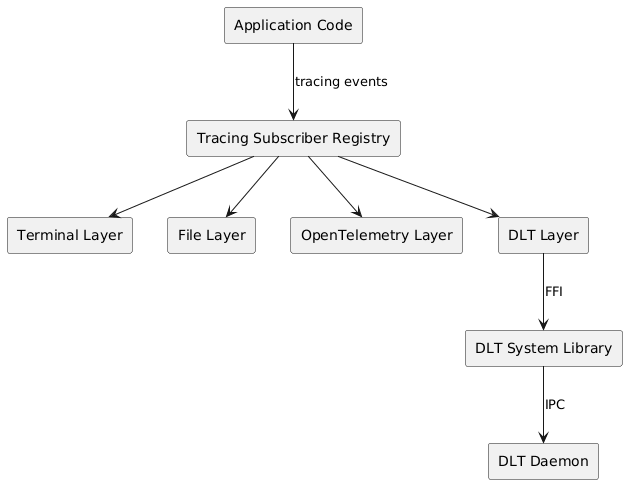
The DLT logging configuration is part of the application-wide logging configuration and is deserialized from the configuration file. The configuration contains the following parameters:
The application ID is validated against DLT protocol constraints during initialization. An invalid application ID (e.g. exceeding 4 characters) prevents the DLT layer from being created and results in a startup error. |
Each subsystem of the CDA annotates its tracing spans with a DLT context identifier. The DLT subscriber layer reads the context identifier from the span metadata and uses it to route the log message to the appropriate DLT context. A helper macro is provided to annotate tracing spans with context identifiers. The macro is feature-gated:
The following context identifiers are used by the CDA subsystems:
|