3.6.7. Vehicle Topology Plugin

Software Architecture: Vehicle Topology Plugin - Retrieval arch~plugin-vehicle-topology-retrieval
status: draft

The vehicle topology plugin provides the SOVD API with information about the network structure of the vehicle, exposed via the following endpoint:

Vehicle Topology Endpoint

Method

Path

Description

GET

/apps/sovd2uds/data/networkstructure

Returns the network structure of the vehicle, consisting of functional groups and gateways.

The response data consists of:

  • Functional groups – a qualifier, and the list of ECUs belonging to that functional group.

  • Gateways – a name, network address, logical address, and the list of ECUs reachable through that gateway.

  • ECUs – a qualifier (name), current variant/connectivity state (with the internal AssumedOnline state, see ECU States (arch~dt-ecu-states), reported as Online), a last_seen timestamp, logical address, and logical link name, for each ECU listed under a functional group or a gateway.

While a networkreset execution is in progress, this endpoint must respond with 409 Conflict, to avoid returning stale or partially updated topology data during the reset.

Software Architecture: Vehicle Topology Plugin - Reset arch~plugin-vehicle-topology-reset
status: draft

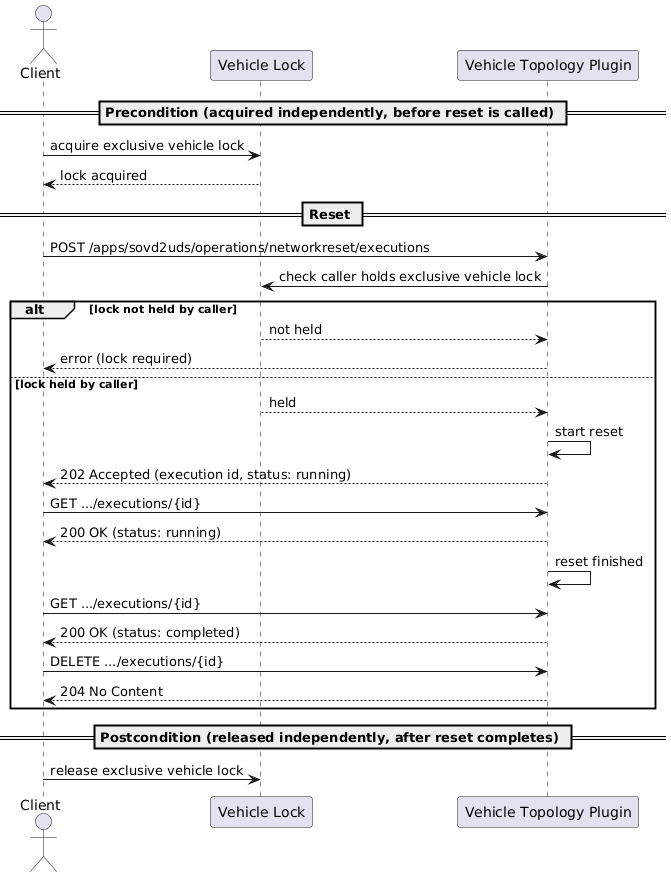
The plugin must provide a networkreset operation, following the standard SOVD operations semantics used elsewhere in the CDA (e.g. runtimefilesupdate):

Vehicle Topology Reset Operation

Method

Path

Description

GET

/apps/sovd2uds/operations

Includes networkreset in the list of available operations.

GET

/apps/sovd2uds/operations/networkreset/executions

Returns the list of current execution identifiers. Always contains at most one entry.

POST

/apps/sovd2uds/operations/networkreset/executions

Starts a new execution of the network reset. Returns 202 Accepted with the execution ID.

GET

/apps/sovd2uds/operations/networkreset/executions/{id}

Returns the status of a specific execution by its ID.

DELETE

/apps/sovd2uds/operations/networkreset/executions/{id}

Terminates the execution (if possible, and not yet stopped) and removes it. Returns 204 No Content.

Triggering a reset must cause the plugin to start re-discovering/re-reporting the vehicle’s network structure, so that subsequent reads of GET /apps/sovd2uds/data/networkstructure reflect the up-to-date topology once the execution has completed.

Starting a networkreset execution requires the caller to already hold an exclusive vehicle lock, acquired independently beforehand, to ensure that no diagnostic operations are in progress while the network structure is being reset. This includes functional and component locks – the reset must not be started while any diagnostic operation is in progress.

@startuml
actor Client
participant "Vehicle Lock" as lock
participant "Vehicle Topology Plugin" as plugin

== Precondition (acquired independently, before reset is called) ==
Client -> lock : acquire exclusive vehicle lock
lock --> Client : lock acquired

== Reset ==
Client -> plugin : POST /apps/sovd2uds/operations/networkreset/executions
plugin -> lock : check caller holds exclusive vehicle lock
alt lock not held by caller
    lock --> plugin : not held
    plugin --> Client : error (lock required)
else lock held by caller
    lock --> plugin : held
    plugin -> plugin : start reset
    plugin --> Client : 202 Accepted (execution id, status: running)
    Client -> plugin : GET .../executions/{id}
    plugin --> Client : 200 OK (status: running)
    plugin -> plugin : reset finished
    Client -> plugin : GET .../executions/{id}
    plugin --> Client : 200 OK (status: completed)
    Client -> plugin : DELETE .../executions/{id}
    plugin --> Client : 204 No Content
end

== Postcondition (released independently, after reset completes) ==
Client -> lock : release exclusive vehicle lock
@enduml

3.6.8. Reset with Persisted List Control

Software Architecture: Vehicle Topology Plugin - Reset with Persisted List Control arch~plugin-vehicle-topology-reset-persistence

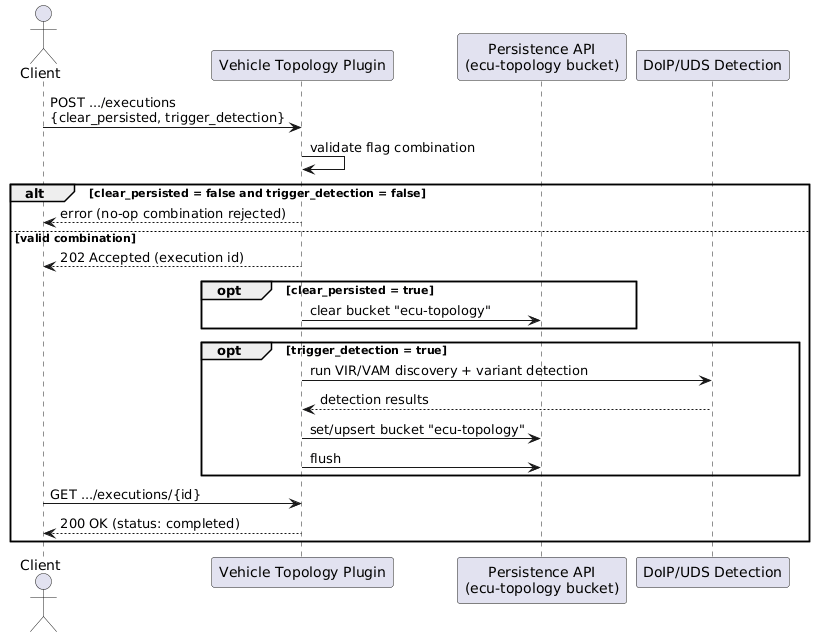
The POST /apps/sovd2uds/operations/networkreset/executions request body accepts two independent, optional boolean fields, both defaulting to true:

networkreset Request Body

Field

Default

Description

clear_persisted

true

Clear the persisted ECU topology (see ECU List Persistence (arch~dt-ecu-list-persistence)) as part of this execution.

trigger_detection

true

Perform a live ECU detection run (VIR/VAM discovery and variant detection) as part of this execution.

Handling of the four flag combinations:

  • clear_persisted=true, trigger_detection=true: the persisted “ecu-topology” bucket is cleared first, then a full detection run is performed and its results are persisted – functionally equivalent to the previously specified networkreset behavior.

  • clear_persisted=true, trigger_detection=false: the persisted “ecu-topology” bucket is cleared and no detection is performed; no vehicle communication occurs. Subsequent CDA behavior (until the next networkreset or restart) follows Communication Initializatio... (arch~dt-deferred-initialization) as if no persisted topology had ever existed.

  • clear_persisted=false, trigger_detection=true: a detection run is performed and its results are upserted per-gateway into the existing persisted topology; entries for gateways/ECUs not observed during this run are left unchanged in the persisted bucket.

  • clear_persisted=false, trigger_detection=false: rejected with an error response, as this combination would perform no observable action.

When communication.ecu_list_persistence.enabled is false (see ECU List Persistence (arch~dt-ecu-list-persistence)), there is no ecu-topology bucket to operate on; clear_persisted is then a no-op regardless of its value, and only trigger_detection has an observable effect (running or skipping a live detection).

@startuml
actor Client
participant "Vehicle Topology Plugin" as plugin
participant "Persistence API\n(ecu-topology bucket)" as Persist
participant "DoIP/UDS Detection" as Detect

Client -> plugin : POST .../executions\n{clear_persisted, trigger_detection}
plugin -> plugin : validate flag combination
alt clear_persisted = false and trigger_detection = false
    plugin --> Client : error (no-op combination rejected)
else valid combination
    plugin --> Client : 202 Accepted (execution id)
    opt clear_persisted = true
        plugin -> Persist : clear bucket "ecu-topology"
    end
    opt trigger_detection = true
        plugin -> Detect : run VIR/VAM discovery + variant detection
        Detect --> plugin : detection results
        plugin -> Persist : set/upsert bucket "ecu-topology"
        plugin -> Persist : flush
    end
    Client -> plugin : GET .../executions/{id}
    plugin --> Client : 200 OK (status: completed)
end
@enduml

networkreset with Persisted List Control